Oracle Exadata Database Cloning: Challenges, Methods, Performance and Best Practices
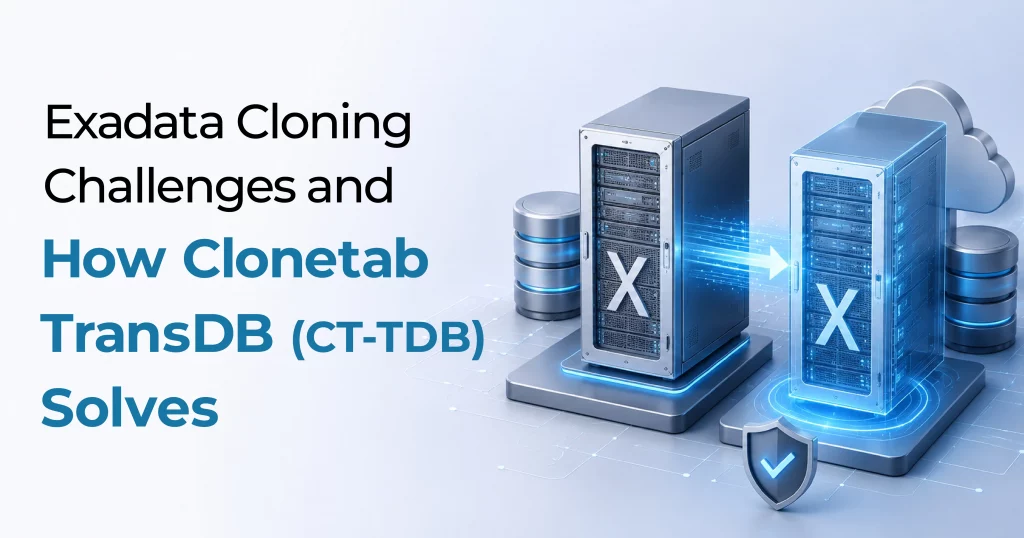
Table of Contents
Oracle Exadata is used by many companies to run large and important databases. It is designed for high performance, fast processing, and handling critical business workloads such as banking, telecom, healthcare, retail, and enterprise applications.
Along with production databases, companies also need extra environments for:
- Development
- Testing
- QA
- UAT
- Reporting
- Training
To create these environments, companies use database cloning.
Database cloning means creating a copy of an existing database and using it in another environment. The cloned database usually contains the same structure, users, tables, and data as the source database at the time of cloning.
This helps teams work in a safe environment without affecting the live production database.
What is Exadata Cloning?
Exadata cloning is the process of taking a source database and creating another usable copy for a target purpose.
Examples:
- Production to QA
- Production to UAT
- QA to Development
- Monthly refresh for testing systems
- Reporting database copy
The cloned database allows teams to test new releases, validate changes, train users, and run reports without touching production systems.
This is very important because production databases should remain stable and secure.
Why Exadata Cloning is Important
Modern companies release new features regularly. Applications need constant updates and testing.
Without cloning:
- Developers cannot test with real-like data
- QA teams may miss production issues
- UAT users may not validate correctly
- Reports may affect production performance
With cloning:
- Teams get realistic environments
- Testing quality improves
- Production risk reduces
- Business delivery becomes faster
Problems in Traditional Exadata Cloning
1. Slow Clone Creation
Large databases may take many hours or even days to clone.
This delays developers, testers, and business users.
2. More Manual Work
Traditional cloning often needs many repeated tasks such as:
- Preparing clone requests
- Running clone steps
- Updating settings
- Validating environments
- Cleanup after completion
This increases DBA workload.
3. Frequent Errors
Manual work can lead to mistakes such as:
- Wrong target selected
- Missing settings
- Incomplete setup
- Failed validations
Even small mistakes can delay projects.
4. Difficult Refresh Process
QA and UAT systems need latest data regularly.
Doing refresh manually every week or month becomes difficult.
5. Higher Resource Usage
Traditional cloning may use more storage and more operational effort.
6. Poor Visibility
Users may not know:
- Current clone status
- Completion time
- Failure reason
This creates confusion.
How Clonetab TransDB(CT-TDB) Solves These Problems
CTTDB helps organizations simplify Exadata cloning and refresh operations.
It gives many benefits:
- Fast snapshots
- Fast database copies
- Better storage usage
- Easy refresh process
- Centralized management
1. Fast Snapshots
CTTDB can create snapshots quickly, helping clone requests start faster.
2. Fast Database Copies
Clone environments can be created faster than traditional methods.
This helps teams get systems quickly.
3. Better Storage Usage
CTTDB uses storage more efficiently and avoids unnecessary duplicate copies.
4. Easy Refresh Process
Existing QA, UAT, and Dev environments can be refreshed quickly with latest data.
5. Centralized Management
Clone requests, refresh operations, and environment management can be handled in one controlled place.
6. Less Manual Work
Many repeated tasks are simplified, reducing DBA effort.
7. Fewer Errors
A controlled cloning process reduces common manual mistakes.
8. Better Productivity
When environments are ready faster:
- Developers start work sooner
- Testing finishes sooner
- Releases move faster
Real Example
Suppose a company needs:
- Weekly QA refresh
- Monthly UAT clone
- New Dev environment
Without CTTDB
- More waiting time
- More manual effort
- More delays
With CTTDB
- Faster cloning
- Quick refresh
- Better control
- Less manual work
Conclusion
Exadata cloning is very important for modern companies because multiple teams need safe and updated database environments.
Traditional cloning can be slow and difficult to manage.
Clonetab TransDB(CTTDB) solves these problems by making cloning:
- Faster
- Easier
- More reliable
- Better managed
- More efficient
For companies using Oracle Exadata, CTTDB is a smart solution for handling database clones and refresh environments.