From Repeated DBA Issues to Intelligent Resolution: Building CT AI Assistant Using RAG
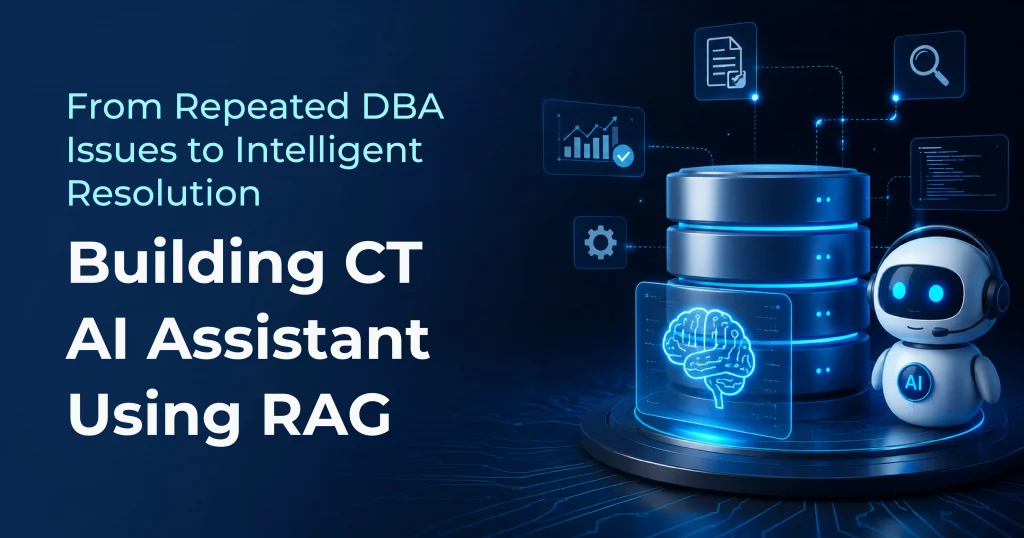
Table of Contents
In high-availability database environments, the cost of delayed issue resolution is not just technical—it directly impacts business continuity. Database administrators (DBAs) are constantly diagnosing performance bottlenecks, resolving failures, and handling operational anomalies. Over time, many of these issues repeat, often with slight variations.
However, the real challenge is not solving these problems—it is retaining and reusing the knowledge effectively.
At Clonetab IT Solutions, we identified that despite having documentation practices in place, knowledge was still fragmented, underutilized, and difficult to operationalize in real-time scenarios.
The Hidden Bottleneck: Knowledge That Exists but Isn’t Usable
Most teams assume documentation solves the knowledge-sharing problem. In reality, it introduces a different kind of friction.
When a DBA documents an issue, the information is usually:
- Written in a context-specific manner
- Stored in static formats (documents, tickets, logs)
- Difficult to search semantically
- Time-consuming to interpret under pressure
As a result, when the same issue resurfaces, engineers often rely on memory, peer communication, or re-analysis instead of leveraging existing knowledge.
This is not a tooling problem—it is a knowledge retrieval problem.
Rethinking the Solution: From Documentation to Intelligence
Instead of improving documentation, we asked a different question:
What if DBAs could interact with past knowledge the same way they interact with a senior engineer?
This led to the development of CT AI Assistant, an internal AI system designed to transform static DBA knowledge into an interactive, quarriable intelligence layer.
Why Retrieval-Augmented Generation (RAG)?
Traditional AI models rely heavily on pre-trained knowledge, which makes them unsuitable for domain-specific, constantly evolving environments like database operations.
RAG fundamentally changes this by introducing a hybrid approach:
- It retrieves relevant, context-specific data from a curated knowledge base
- It generates responses grounded in that data
This ensures that answers are not just fluent—but factually aligned with internal systems and past resolutions
In our case, this was critical because DBA issues often involve precise configurations, environment-specific behaviours, and historical context.
System Architecture and Design Approach
The CT AI Assistant is built using:
- Spring Boot to handle scalable backend services
- LangChain4j to orchestrate the RAG pipeline and manage interaction with large language models
The system is intentionally designed with a clear separation between knowledge ingestion and knowledge retrieval, ensuring flexibility and scalability.
Turning DBA Knowledge into a Quarriable System
Knowledge Ingestion Pipeline
Every resolved issue becomes an input to the system. Instead of treating documentation as static text, we transform it into structured, retrievable knowledge.
This involves:
- Collecting resolution documents from DBAs
- Processing and segmenting the content
- Storing it in a format optimized for semantic retrieval
Over time, this creates a continuously evolving knowledge base that reflects real operational experience.
Context-Aware Query Processing
When a DBA interacts with CT AI Assistant, the system does not rely on guesswork. Instead, it:
- Identifies the intent behind the query
- Retrieves the most relevant historical contexts
- Generates a response grounded in actual past resolutions
This approach ensures that responses are not generic, but context-sensitive and operationally useful.
Measurable Impact on DBA Operations
The shift from passive documentation to active intelligence has significantly improved how our teams operate.
Key outcomes include:
- Reduced Mean Time to Resolution (MTTR) for recurring issues
- Lower cognitive load on engineers during incident handling
- Decentralized knowledge access, reducing reliance on specific individuals
- Improved consistency in issue resolution approaches
More importantly, it changes how teams think about knowledge—not as something to store, but as something to interact with.
Strategic Value for Clonetab IT Solutions
For Clonetab IT Solutions, CT AI Assistant represents more than a productivity tool. It is a step toward building AI-augmented engineering workflows.
By embedding intelligence into everyday operations, we are:
- Enhancing decision-making speed
- Creating a scalable knowledge ecosystem
- Laying the foundation for future AI-driven automation
What’s Next?
While the current system focuses on knowledge retrieval, the next phase is about proactive intelligence.
We are exploring:
- Real-time integration with monitoring systems for automated insights
- Pattern detection across recurring incidents
- Suggestion systems for preventive actions
The long-term vision is not just to assist DBAs, but to anticipate and prevent issues before they occur.
Conclusion
CT AI Assistant demonstrates how combining modern AI approaches like RAG with real-world engineering challenges can unlock significant value.
At its core, this is not just about AI—it is about making knowledge truly usable.
And in complex systems, that is often the difference between reacting to problems and staying ahead of them.